
UPDATED: What to Expect Weather-Wise at Morgan Wallen Show in Tuscaloosa
The day fans have been eagerly awaiting has arrived: Morgan Wallen's “Still the Problem” Tour at Saban Field at Bryant-Denny Stadium at 5:30 p.m.
Adding another level of excitement, this is the first concert hosted at Bryant-Denny Stadium in 43 years.
As you get ready to head out to the concert, it’s worth keeping an eye on the forecast and planning for any changing conditions. James Spann, Alabama Weather Network and Townsquare Media Tuscaloosa Chief Meteorologist, has encouraged concert attendees to “be sure to have some rain gear.”
Don’t forget that one of the several “prohibited items” is an umbrella. I would suggest a lightweight poncho that folds into a pocket. Click here for a full list of items not permitted in the stadium.
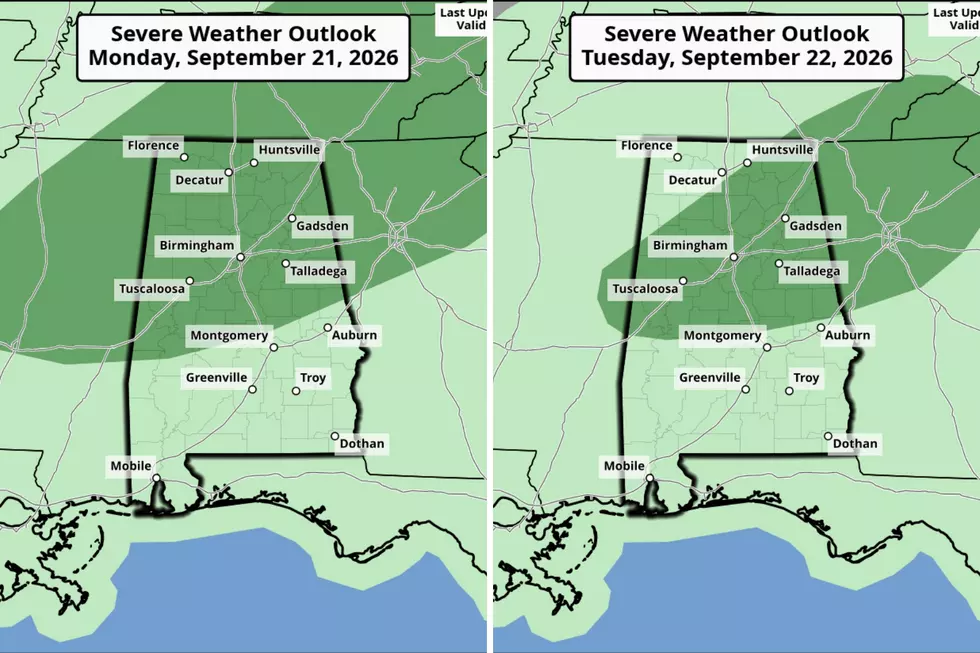
“A few isolated showers are possible in Tuscaloosa as early as 5:00, but the more widespread rain will come after 7 p.m.,” said Spann. “Some lightning is very possible, but we don't expect any threat of severe thunderstorms. Temperatures will fall from the low 80s at 6:00 into the upper 70s by 8 p.m.”
UPDATED: Morgan Wallen Concert Hour-by-Hour Weather Guide
These are the current predicted percentages for the precipitation potentials, rain, and thunder for the Bryant-Denny Stadium area, according to the National Weather Service in Birmingham. As weather conditions change, the hourly forecast may change.
Noon
Precipitation Potential (%): 0%
Rain: <10 %
Thunder: <10 %
1 p.m.
Precipitation Potential (%): 1%
Rain: <10 %
Thunder: <10 %
2 p.m.
Precipitation Potential (%): 1%
Rain: <10 %
Thunder: <10 %
3 p.m.
Precipitation Potential (%): 1%
Rain: <10 %
Thunder: <10 %
4 p.m.
Precipitation Potential (%): 22%
Rain: Slight Chance (10%-20%)
Thunder: <10 %
5 p.m.
Precipitation Potential (%): 22%
Rain: Slight Chance (10%-20%)
Thunder: <10 %
6 p.m.
Precipitation Potential (%): 22%
Rain: Slight Chance (10%-20%)
Thunder: <10 %
7 p.m.
Precipitation Potential (%): 72%
Rain: Likely (60%-70%)
Thunder: Chance (30%-50%)
8 p.m.
Precipitation Potential (%): 72%
Rain: Likely (60%-70%)
Thunder: Chance (30%-50%)
9 p.m.
Precipitation Potential (%): 72%
Rain: Likely (60%-70%)
Thunder: Chance (30%-50%)
10 p.m.
Precipitation Potential (%): 82%
Rain: Occasional (80%-100%)
Thunder: Slight Chance (10%-20%)
11 p.m.
Precipitation Potential (%): 82%
Rain: Occasional (80%-100%)
Thunder: Slight Chance (10%-20%)

UPDATED: Temp, Conditions, and Precipitation Chance Outlook
To take a closer look, here are the current temperatures and conditions around Bryant-Denny Stadium during the concert timeframe, according to The Weather Channel.
Keep in mind, as weather conditions shift, the hourly forecast may also change.
5 p.m.: 81 °F | Mostly Cloudy | Precipitation Chance 19%
6 p.m.: 79 °F | Cloudy | Precipitation Chance 24%
7 p.m.: 76 °F | Scattered Thunderstorms | Precipitation Chance 54%
8 p.m.: 72 °F | Thunderstorms | Precipitation Chance 83%
9 p.m.: 68 °F | Scattered Thunderstorms | Precipitation Chance 54%
10 p.m.: 65 °F | Scattered Thunderstorms | Precipitation Chance 54%
11 p.m.: 61 °F | Showers | Precipitation Chance 52%
Mary K. – Weather Forecaster
LOOK: The most extreme temperatures in the history of every state
Gallery Credit: Anuradha Varanasi
LOOK: The most expensive weather and climate disasters in recent decades
Gallery Credit: KATELYN LEBOFF
More From 92.9 WTUG